A Self-Employed Taxpayer Experimental Study on Trust, Power, and Tax Compliance in Eleven Countries
Nov 23, 2022·,, ,,,,,,,,,,,,,,,·
0 min read
,,,,,,,,,,,,,,,·
0 min read
Larissa M. Batrancea
Anca Nichita
Ruggero De Agostini
Fabricio Batista Narcizo
Denis Forte
Samuel de Paiva Neves Mamede
Ana Maria Roux-Cesar
Bozhidar Nedev
Leoš Vitek
József Pántya
Aidin Salamzadeh
Eleanya K. Nduka
Janusz Kudła
Mateusz Kopyt
Luis Pacheco
Isabel Maldonado
Nsubili Isaga
Serkan Benk
Tamer Budak
Abstract
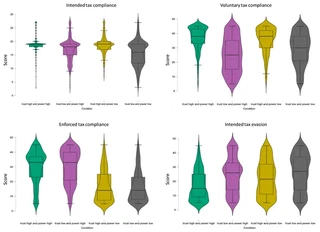
The slippery slope framework explains tax compliance along two main dimensions, trust in authorities and power of authorities, which influence taxpayers’ compliance attitudes. Through frequentist and Bayesian analyses, we investigated the framework’s assumptions on a sample of 2786 self-employed taxpayers from eleven post-communist and non-post-communist countries doing business in five economic branches. After using scenarios that experimentally manipulated trust and power, our results confirmed the framework’s assumptions regarding the attitudes of the self-employed taxpayers; trust and power fostered intended tax compliance and diminished tax evasion, trust boosted voluntary tax compliance, whereas power increased enforced tax compliance. Additionally, self-employed taxpayers from post-communist countries reported higher intended tax compliance and lower tax evasion than those from non-post-communist countries. Our results offer tax authorities insights into how trust and power may contribute to obtaining and maintaining high tax compliance levels amid global economic challenges, downturns, and increasing tax compliance costs.
Type
Publication
In Financial Innovation, 8(96)

Authors
Fabricio Batista Narcizo
(he/him)
Senior AI Research Scientist
Fabricio Batista Narcizo is a Senior AI Research Scientist in the Video Technology department at GN Hearing A/S (Jabra) and a Part-Time Lecturer and Course Manager at the IT University of Copenhagen (ITU). He received his Ph.D. degree in Computer Science from the ITU in 2017, his M.Sc. degree in Electronic & Computer Engineering from the Aeronautics Institute of Technology (ITA) in 2008, and his B.Sc. degree in Computer Science from the University of Western Santa Catarina (UNOESC) in 2005. His research interests lie in computer vision, image analysis, artificial intelligence, data science, data mining, machine learning, edge AI, and human-computer interaction, with a particular interest in eye-tracking.