Universal Hand Gesture Interaction Vocabulary for Cross-Cultural Users: Challenges and Approaches
Jun 1, 2024· ,,·
0 min read
,,·
0 min read
Elizabete Munzlinger
Fabricio Batista Narcizo
Dan Witzner Hansen
Ted Vucurevich
Abstract
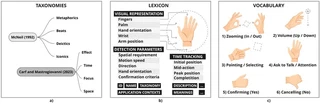
This paper highlights the complexity of creating a universal, cross-cultural Hand Gesture Recognition (HGR) vocabulary for global products and systems where worldwide users interact by sharing the same system or space. We revisit the concept of an idealistic universal HGR vocabulary for cross-cultural users and systems that suit all users and present potential development challenges by reviewing the hand gesture taxonomy, lexical, vocabulary, and the current design methods. The analysis emphasizes the importance of creating a cohesive movement towards standardizing HGR vocabulary for innovative products and services that accommodate cultural diversity and converge for a universal agreement at some point.
Type
Publication
In HCI International 2024 Posters
Hand Gesture
Hand Gesture Interaction
Universal Vocabulary
Lexicon
Taxonomy
Cross-Cultural Users
Human-Computer Interaction
Design Methods
Global Users
Global Products and Systems

Authors
Fabricio Batista Narcizo
(he/him)
Senior AI Research Scientist
Fabricio Batista Narcizo is a Senior AI Research Scientist in the Video Technology department at GN Hearing A/S (Jabra) and a Part-Time Lecturer and Course Manager at the IT University of Copenhagen (ITU). He received his Ph.D. degree in Computer Science from the ITU in 2017, his M.Sc. degree in Electronic & Computer Engineering from the Aeronautics Institute of Technology (ITA) in 2008, and his B.Sc. degree in Computer Science from the University of Western Santa Catarina (UNOESC) in 2005. His research interests lie in computer vision, image analysis, artificial intelligence, data science, data mining, machine learning, edge AI, and human-computer interaction, with a particular interest in eye-tracking.