Eliciting User-Defined Mid-Air Hand Gestures for Hybrid Meeting Platform Control: Results, Insights, and Design Implications
Sep 9, 2025· ,,,,·
0 min read
,,,,·
0 min read
Elizabete Munzlinger
Fabricio Batista Narcizo
Renata Briet
Mario Tadashi Shimanuki
Ted Vucurevich
Dan Witzner Hansen
Abstract
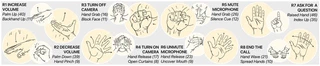
Although hand gesture interaction is widely employed across a range of interactive systems, it remains comparatively underexplored within unified communication platforms (UCPs), particularly in the context of hybrid meeting environments that demand intuitive and seamless control and could benefit markedly from a spontaneous, touch-free control. Existing gesture vocabularies remain insufficiently aligned with the context of meetings and their functional controls. To address this lacuna, we conducted an elicitation study with 103 participants, each of whom proposed a gesture for eight core UCP commands. We report the resulting (824 proposals; 133 unique gestures), a four-dimensional taxonomy, an AI-based (LLM) classification, and agreement/dissimilarity analyses. Overall agreement was low (AR = 0.12) yet peaked at 0.31 for the Ask-Question referent (46/103); the dissimilarity-consensus metric mirrored this pattern (30.9% versus ≤ 3.5% for camera controls). Gestures were predominantly simple (one gesture per unit) (91%) and dynamic (75%), with the most common iconic (38%) and symbolic (27%) forms. Three LLMs assigned taxonomy labels with substantial inter-model agreement (k=0.74~0.88), requiring manual tie-breaks for only 0.015% of the samples. We release the corpus and codes to enable reproducibility.
Type
Publication
In Human-Computer Interaction – INTERACT 2025
Hand Gesture
Gesture Elicitation
User-Defined
Mid-Air Hand Gestures
Hybrid Meeting Context
Unified Communication Platforms (UCPs)

Authors
Fabricio Batista Narcizo
(he/him)
Senior AI Research Scientist
Fabricio Batista Narcizo is a Senior AI Research Scientist in the Video Technology department at GN Hearing A/S (Jabra) and a Part-Time Lecturer and Course Manager at the IT University of Copenhagen (ITU). He received his Ph.D. degree in Computer Science from the ITU in 2017, his M.Sc. degree in Electronic & Computer Engineering from the Aeronautics Institute of Technology (ITA) in 2008, and his B.Sc. degree in Computer Science from the University of Western Santa Catarina (UNOESC) in 2005. His research interests lie in computer vision, image analysis, artificial intelligence, data science, data mining, machine learning, edge AI, and human-computer interaction, with a particular interest in eye-tracking.