Remote Eye Tracking Systems: Technologies and Applications
Aug 5, 2013· ,,·
0 min read
,,·
0 min read
Fabricio Batista Narcizo
José Eustáquio Rangel de Queiroz
Herman Martins Gomes
Abstract
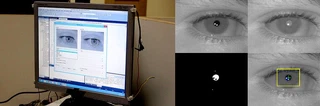
Eye tracking is an active multidisciplinary research field, which has shown great progress in the last decades. Eye tracking is the process of monitoring eye movements in order to determine the point of gaze or to analyze motion patterns of an eye relative to the head or the environment. This process provides essential information to tasks such as face detection, usability testing, biometric identification, human behavior studies and human-computer interaction, among others. The term remote is used whenever the eye tracker components do not have any physical contact with the user’s body. In general, highly accurate commercial eye trackers are expensive. However, nowadays it is possible to develop low-cost remote eye tracking systems with off-the-shelf hardware components. By this perspective, an overview of eye tracking technologies and applications is given in this paper, and the state-of-the-art work in the field is discussed as well. Moreover, hardware components and underlying computer vision processes are also presented in this paper.
Type
Publication
In 2013 26th Conference on Graphics, Patterns and Images Tutorials
Eye-Tracking
Point of Gaze
Line of Sight
Point of Regard
Remote Eye Tracking Systems
Remote Eye Tracker
Computer Vision
Digital Image Processing
Off-the-Shelf Components

Authors
Fabricio Batista Narcizo
(he/him)
Senior AI Research Scientist
Fabricio Batista Narcizo is a Senior AI Research Scientist in the Video Technology department at GN Hearing A/S (Jabra) and a Part-Time Lecturer and Course Manager at the IT University of Copenhagen (ITU). He received his Ph.D. degree in Computer Science from the ITU in 2017, his M.Sc. degree in Electronic & Computer Engineering from the Aeronautics Institute of Technology (ITA) in 2008, and his B.Sc. degree in Computer Science from the University of Western Santa Catarina (UNOESC) in 2005. His research interests lie in computer vision, image analysis, artificial intelligence, data science, data mining, machine learning, edge AI, and human-computer interaction, with a particular interest in eye-tracking.