Using Priors to Improve Head-Mounted Eye Trackers in Sports

Abstract
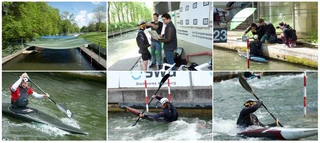
This Ph.D. thesis is about using available information known from the problem at hand (aka priors), with the aim to enhance the performance of head-mounted eye trackers. Prior information is used for eye tracking scenarios in different sports disciplines to improve the accuracy and robustness of gaze estimation in critical situations. This thesis also explores off-the-shelf hardware to build flexible and adaptable eye trackers that exploit the constraints revealed for specific sports settings. Several eye tracking methods are presented, in which the use of priors plays the leading role. The compensation models proposed in this thesis ranging from solving geometrical constraints of head-mounted eye trackers to eye feature detection in challenging environment lighting conditions. The experiments focused on different sports disciplines to collect and analyze eye tracking data involving elite athletes during the daily training sessions of shooting and kayak as well as some laboratory experiments. The results of the experiments showed that the use of priors is very promising to the field of eye tracking, such as (i) using the distance between the athlete and the observed target as priors, to reduce the influence of parallax error in 80.59%; (ii) using the 3D angles from the athlete{\textquoteright}s head as priors, to reduce the influence of head rotation in 86.41%; (iii) using the geometric relation of human ocular system as priors, to make eye tracking more robust to eye feature noise, among others. Using priors in different steps of an eye tracking system has a general and substantial impact on eye trackers in general. While the focus of this thesis is in the use of eye tracking in sports, it is evident that progress achieved within this project on gaze estimation for sports activities has a direct impact on other areas that use eye tracking as well.
Type
Publication
IT-Universitetet i København

Authors
Fabricio Batista Narcizo
(he/him)
Senior AI Research Scientist
Fabricio Batista Narcizo is a Senior AI Research Scientist in the Video Technology department at GN Hearing A/S (Jabra) and a Part-Time Lecturer and Course Manager at the IT University of Copenhagen (ITU). He received his Ph.D. degree in Computer Science from the ITU in 2017, his M.Sc. degree in Electronic & Computer Engineering from the Aeronautics Institute of Technology (ITA) in 2008, and his B.Sc. degree in Computer Science from the University of Western Santa Catarina (UNOESC) in 2005. His research interests lie in computer vision, image analysis, artificial intelligence, data science, data mining, machine learning, edge AI, and human-computer interaction, with a particular interest in eye-tracking.