High-Accuracy Gaze Estimation for Interpolation-Based Eye-Tracking Methods
Sep 15, 2021· ,,·
0 min read
,,·
0 min read
Fabricio Batista Narcizo
Fernando Eustáquio Dantas dos Santos
Dan Witzner Hansen
Abstract
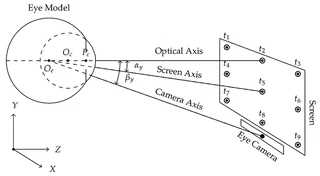
This study investigates the influence of the eye-camera location associated with the accuracy and precision of interpolation-based eye-tracking methods. Several factors can negatively influence gaze estimation methods when building a commercial or off-the-shelf eye tracker device, including the eye-camera location in uncalibrated setups. Our experiments show that the eye-camera location combined with the non-coplanarity of the eye plane deforms the eye feature distribution when the eye-camera is far from the eye’s optical axis. This paper proposes geometric transformation methods to reshape the eye feature distribution based on the virtual alignment of the eye-camera in the center of the eye’s optical axis. The data analysis uses eye-tracking data from a simulated environment and an experiment with 83 volunteer participants (55 males and 28 females). We evaluate the improvements achieved with the proposed methods using Gaussian analysis, which defines a range for high-accuracy gaze estimation between -0.5˚ and 0.5˚. Compared to traditional polynomial-based and homography-based gaze estimation methods, the proposed methods increase the number of gaze estimations in the high-accuracy range.
Type
Publication
Vision, 5(3)

Authors
Fabricio Batista Narcizo
(he/him)
Senior AI Research Scientist
Fabricio Batista Narcizo is a Senior AI Research Scientist in the Video Technology department at GN Hearing A/S (Jabra) and a Part-Time Lecturer and Course Manager at the IT University of Copenhagen (ITU). He received his Ph.D. degree in Computer Science from the ITU in 2017, his M.Sc. degree in Electronic & Computer Engineering from the Aeronautics Institute of Technology (ITA) in 2008, and his B.Sc. degree in Computer Science from the University of Western Santa Catarina (UNOESC) in 2005. His research interests lie in computer vision, image analysis, artificial intelligence, data science, data mining, machine learning, edge AI, and human-computer interaction, with a particular interest in eye-tracking.